Why I Stick to Qigong Every Morning — And Why You Might Want To
For years, I struggled with low energy and mental fog, no matter how much I slept. Then I discovered qigong — not as a quick fix, but as a daily rhythm. Practicing just 15 minutes each morning changed how I feel, think, and move through the day. This isn’t magic — it’s consistency. In this article, I’ll explain how regular qigong practice supports long-term wellness, based on traditional Chinese medicine principles and real-life experience.
The Burnout Breakthrough: Why Routine Matters in Wellness
In today’s fast-paced world, many women in their 30s to 50s face a quiet but persistent challenge: burnout disguised as routine. Juggling family responsibilities, work demands, and personal well-being often leads to self-care being pushed aside or practiced sporadically. A yoga class here, a meditation app there — these are helpful, but when they lack consistency, their benefits remain fleeting. The real shift in health doesn’t come from occasional intensity, but from gentle, repeated actions woven into daily life. This is where qigong stands apart.
Unlike high-effort workouts that can feel like another obligation, qigong is designed to be sustainable. It meets you where you are — whether you're stiff from sitting, tired from a restless night, or emotionally drained. The practice asks only for presence, not performance. By engaging in the same simple movements and breathing patterns each morning, the body begins to recognize and respond to this rhythm. Over time, this consistency helps regulate internal systems, much like a steady heartbeat stabilizes circulation.
Modern science supports this idea. Studies on habit formation show that behaviors repeated at the same time and place become automatic, reducing mental effort and increasing long-term adherence. When applied to wellness, this means that a 15-minute qigong routine done every morning can become as natural as brushing your teeth. The key is not how hard you practice, but how regularly. It’s this daily commitment — small but unwavering — that creates lasting improvements in energy, mood, and focus.
What Is Qigong? A Simple Explanation from a Skeptic Turned Believer
If you’ve never tried qigong, the term might sound mysterious or even mystical. But at its core, qigong is simply the coordination of breath, gentle movement, and mindful awareness. The word itself comes from Chinese: *qi* meaning “vital energy” or “life force,” and *gong* meaning “practice” or “skill cultivated over time.” So, qigong translates to “the practice of cultivating life energy.” This doesn’t require belief in unseen forces — it’s about tuning into the very real sensations of breath, posture, and flow within the body.
Rooted in traditional Chinese medicine (TCM), qigong has been practiced for thousands of years to support health, prevent illness, and promote longevity. According to TCM, the body contains energy pathways called meridians, through which *qi* flows. When this flow is smooth and balanced, the body functions optimally. When it’s blocked or disrupted — due to stress, poor posture, or emotional strain — discomfort and fatigue can follow. Qigong helps restore balance by encouraging the free movement of *qi* through intentional breathing and slow, flowing motions.
Like many modern women, I was initially skeptical. The idea of “energy flow” sounded vague, even a little too spiritual. But what changed my mind was not theory — it was experience. After just a few weeks of daily practice, I noticed subtle shifts: I woke up feeling more alert, my shoulders stayed relaxed throughout the day, and I reacted more calmly to stressful moments. These weren’t dramatic transformations, but they were real. And they came not from pushing harder, but from showing up gently, every morning, with the same quiet intention.
How Daily Practice Rewires Your Body’s Rhythm
One of the most powerful aspects of a morning qigong routine is its ability to align with the body’s natural circadian rhythm. Our bodies thrive on predictability — when we eat, sleep, and move at consistent times, our internal systems function more efficiently. Morning, in particular, is a crucial window for setting the tone of the day. By starting with slow, intentional movements and deep breathing, you signal to your nervous system that it’s time to awaken gently, not rush into action.
This has a direct impact on the autonomic nervous system, which controls functions like heart rate, digestion, and stress response. Most adults spend too much time in “fight-or-flight” mode — a state driven by the sympathetic nervous system — due to constant demands and digital overload. Qigong activates the parasympathetic nervous system, often called the “rest-and-digest” mode. This shift doesn’t happen instantly, but with regular practice, the body becomes better at returning to calm, even in stressful situations.
Over time, this recalibration leads to measurable benefits. Many women report improved sleep quality, as the body learns to wind down more easily at night. Digestion often becomes more regular, since the parasympathetic state supports optimal gut function. Emotions, too, become more stable — not because life’s challenges disappear, but because the nervous system is less reactive. These changes don’t come from a single session, but from the cumulative effect of daily practice. It’s like watering a plant every day — the growth may be invisible at first, but eventually, the roots run deep.
My Morning Flow: A Breakdown of a Real 15-Minute Routine
When I first started qigong, I worried I wouldn’t have enough time or space. I imagined needing a quiet room, special clothes, or years of training. But what I’ve learned is that the most effective routines are the simplest. My current morning practice takes just 15 minutes and requires nothing more than a small, clear area and comfortable clothing. Here’s how it unfolds — a sequence that’s accessible to anyone, regardless of fitness level or experience.
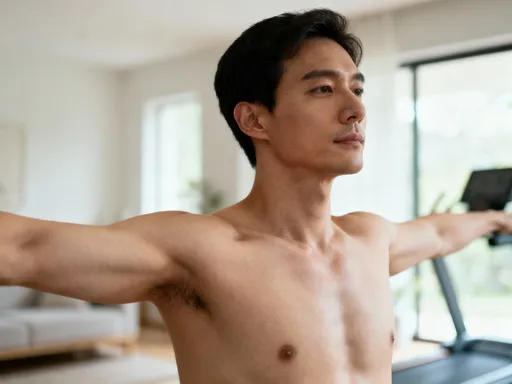
I begin with two minutes of standing meditation, feet shoulder-width apart, knees slightly bent, arms relaxed at my sides. I focus on my breath — slow, deep inhalations through the nose, gentle exhalations through the mouth. This isn’t about controlling the breath, but about observing it, letting it settle into a natural rhythm. This simple act grounds me and signals the start of my practice.
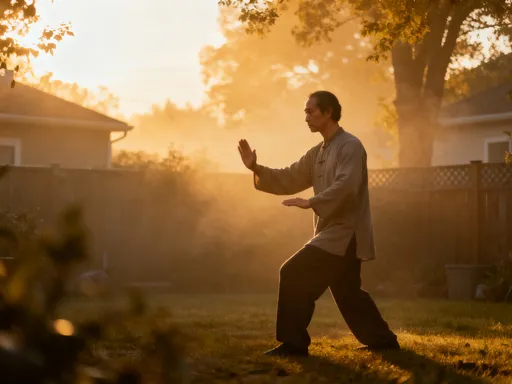
Next, I move into gentle warm-ups: shoulder rolls, neck stretches, and wrist circles. These prepare the body for movement and release tension stored from daily activities. Then comes the core of the practice — a flowing sequence known as “Lifting the Sky.” I raise my arms slowly in front of me, palms up, imagining energy rising from the ground through my feet and up my body. At the top, I gently turn my palms down and lower my hands, visualizing any tension or heaviness releasing into the earth. I repeat this motion for five minutes, syncing each movement with my breath.
The final segment involves “Separating Heaven and Earth,” a movement that alternates one hand rising while the other sinks, creating a gentle stretch through the torso. This is followed by a minute of stillness, returning to standing meditation. The entire routine is low-impact, adaptable, and repeatable. What matters most is not perfection, but continuity. By doing the same sequence every day, my body learns the flow, and the benefits accumulate over time.
The Hidden Power of Repetition: What TCM Teaches About Habitual Practice
In traditional Chinese medicine, health is not seen as the absence of disease, but as a state of balance and flow. This balance is maintained not through occasional interventions, but through daily habits that support the body’s natural rhythms. One key concept is the organ clock, which maps the body’s energy cycles across a 24-hour period. For example, the liver is most active between 1 a.m. and 3 a.m., and the lungs between 3 a.m. and 5 a.m. By aligning practices like qigong with these cycles — particularly in the early morning — you work with, not against, your body’s innate timing.
TCM also emphasizes the importance of meridian regularity. Just as rivers need to flow freely to prevent stagnation, the body’s energy pathways require consistent movement to remain clear. Daily qigong acts like a gentle broom, sweeping away subtle blockages caused by stress, inactivity, or emotional holding. Over time, this supports gradual detoxification — not in a dramatic, extreme sense, but in the quiet, ongoing way the body naturally eliminates waste and renews itself.
This contrasts sharply with the Western tendency to seek quick fixes: intense workouts, detox cleanses, or miracle supplements. While these may offer short-term results, they often lack sustainability. TCM, on the other hand, values cultivation — the slow, steady nurturing of vitality. Think of it like tending a garden: you don’t pull the weeds once and expect perfection forever. You return each day, water the soil, and watch over time as the plants thrive. In the same way, daily qigong isn’t about dramatic change — it’s about creating the conditions for health to flourish naturally.
Overcoming the Obstacles: How I Stayed Consistent (And You Can Too)
Even with the best intentions, consistency can be hard. There were mornings when I hit snooze, when the kids needed help, or when I simply didn’t feel like moving. The difference between those who stick with qigong and those who don’t often comes down to mindset and environment. I learned that expecting perfection was my biggest barrier. Missing a day doesn’t mean failure — it means you’re human. What matters is returning to the practice without guilt or self-criticism.
To support consistency, I made small but powerful changes. I laid out my practice clothes the night before, just like I would for a workout. I cleared a corner of the living room and added a small mat, making the space inviting and ready to use. I also linked my qigong practice to an existing habit — after brushing my teeth, I move straight into my routine. This “habit stacking” technique, supported by behavioral science, makes it easier to follow through.
Another key shift was changing my definition of success. Instead of measuring progress by how flexible I became or how long I could hold a pose, I began to notice subtler signs: a deeper breath, a calmer response to frustration, a moment of presence amid chaos. These small victories kept me motivated. I also reminded myself that qigong isn’t a chore — it’s a gift I give myself, a moment of stillness before the day begins. When viewed this way, it’s not something I have to do, but something I get to do.
From Practice to Lifestyle: How Qigong Changes More Than Your Morning
Perhaps the most surprising benefit of qigong is how its effects ripple outward into daily life. It’s not just about the 15 minutes on the mat — it’s about how those minutes shape the other 1440 minutes of the day. Over time, I’ve noticed a quiet shift in my awareness. I catch myself slouching and correct my posture without thinking. I pause before reacting in anger or frustration. I feel more connected to my body, more present with my family, more grounded in my decisions.
This increased mindfulness isn’t forced — it emerges naturally from the practice. By training the mind to focus on breath and movement, you build the mental muscle of attention. This same skill applies when listening to a child, managing a work deadline, or navigating a difficult conversation. You become less reactive, more responsive. Emotional ups and downs don’t disappear, but they lose their grip. You learn to breathe through discomfort, just as you do in practice.
Physically, the changes are just as meaningful. My energy levels have stabilized — no more mid-afternoon crashes. My sleep has improved, not because I’m trying harder to sleep, but because my body is less tense. Even simple things like digestion and circulation feel smoother. These aren’t dramatic breakthroughs, but they add up to a profound sense of well-being. Qigong has become less of an exercise and more of a daily conversation with my body — a way of listening, honoring, and caring for myself in a world that often asks for everything but gives little back.
Qigong isn’t about dramatic transformation overnight — it’s about showing up, breathing deeply, and trusting the process. When practiced regularly, it becomes less of an exercise and more of a daily conversation with your body. Rooted in ancient wisdom and supported by modern understanding of rhythm and health, this gentle practice offers something rare: sustainable vitality. For anyone seeking calm, clarity, and consistency, it’s worth a try — one breath at a time.